 English
 Italian


KAMM Manufaktur | Not Another Porsche
Interview by Andrea Albertazzi / Photos by KAMM Manufaktur
The mistake one might make is to fall into the most typical cliché, exclaiming, “Ah, another Porsche!” After all, the fact that the Stuttgart sports car has been able to reinvent itself for over half a century while remaining incredibly faithful to itself is well known. The same can be said for all those who, over the decades, have applied their own vision. Some by extracting significantly more horsepower, others by revisiting icons of the past and trying to make them more at ease in the contemporary landscape. You can imagine how difficult it is to make one’s voice stand out among the many others. It takes something different, something distinctive. It requires a proposal that is not commercially inclined to satisfy every single customer request, but one that leads the customer to understand that this specific vision is the best they could find.
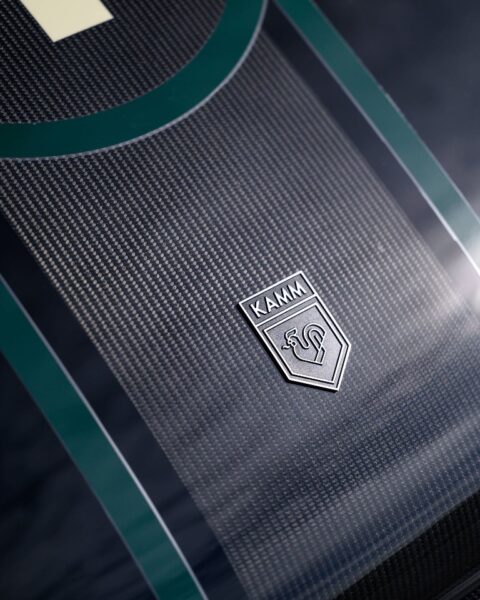

The philosophy of KAMM Manufaktur surprised us precisely for this reason. As Miklosz Kazmer says, “It’s not a blank canvas. Our philosophy is always at the core.” These words make it clear that the primary target is to create a perfect car, one built upon very precise principles. It is a different vision. One that does not chase heart-stopping performance, but rather the ability to rediscover and celebrate the purest driving pleasure, gripping the wheel of an unsuspecting 912.
Let’s make it different and start at the end: is the 912 the ultimate driver’s car?
It might just be. Not because it’s the fastest — far from it — but because it gets the fundamentals absolutely right. It’s light, compact, simple and disarmingly honest. You always know what it’s doing and crucially, you don’t need outrageous speed to enjoy it.
That’s the magic. Real involvement, at real-world pace. These days, that’s a rare thing.
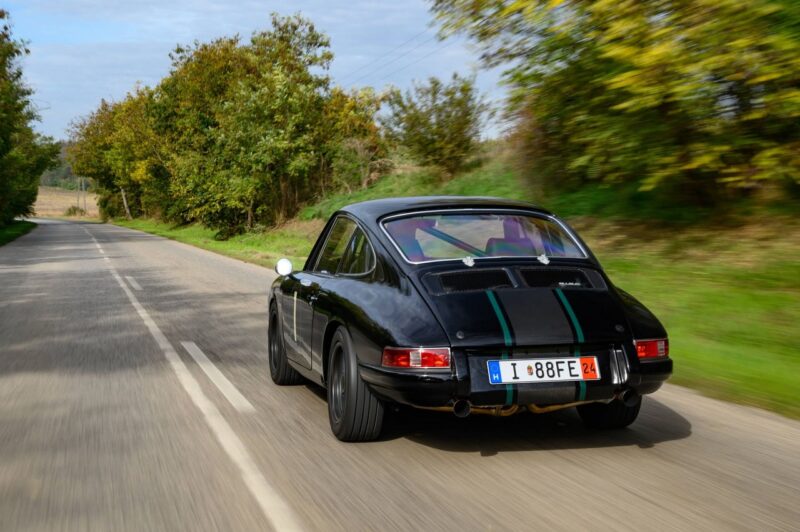
So when did we lose that feeling? How far back do we need to go?
Back to when sports cars were built around lightness and simplicity.
Modern performance cars are astonishing on paper. Faster, grippier, more capable in every measurable sense. But they’re also heavier, more insulated and increasingly dependent on electronics. You gain performance, sure. But you lose something harder to define: intimacy. That direct, mechanical conversation between driver and machine it’s fading.

Where does KAMM Manufaktur come into this?
It began as something deeply personal. I’m a filmmaker, but cars have always been a constant. My father was an engineer and I grew up around a rally garage, so that world was always there, in the background.
Over time came a series of air-cooled projects—restorations, always chasing the same ideals: lightness, balance, simplicity, connection. Then came the 912. It had all the right ingredients and it was an underdog. That mattered. Expectations were low, which made the potential even more exciting. From there, things escalated. Slowly, organically, KAMM took shape.
Was it always meant to become a business?
Not at all. At first, it was just about proving the concept. Seeing if the idea held up in reality. Once it did, the rest followed naturally. The company exists because the car made sense, not the other way around.


So what defines a KAMM 912?
Everyone expects me to say lightness and yes, it’s fundamental. But really, it’s about drivability. Lightness is just the enabler. It sharpens everything: steering, braking, response, agility, balance. The whole car comes alive. Beyond that, it’s about coherence. Every element has to feel like part of a single, unified idea. Nothing random, nothing out of place.
And how long does it take to build one?
Typically 12 to 18 months, depending on the donor and the specification. It starts with a detailed consultation — defining the car, shaping the vision — followed by budgeting and initial renders. Then the real work begins. This isn’t a restoration. It’s a ground-up rethinking, executed with intent. That takes time.
How much input does the customer actually have?
A lot, but within boundaries. There’s always a clear KAMM philosophy underpinning the car, so it’s never a blank canvas. But within that framework, it’s a deeply personal process. Some clients want something more relaxed, more GT. Others want something sharper, more focused. We build around that.
Let’s talk numbers: price and availability.
There are currently three models.
The 912T starts at €245,000 and leans towards a more relaxed, touring character. The 912C begins at €345,000 in Semi-Carbon and €395,000 in Full Carbon. At the top sits the 912C RS: 650 kg, 230 hp, €450,000 and limited to just 9 cars.
Donor cars aren’t included, though we can source them. We currently have examples available in the US and Hungary. Lead time remains around 12 to 18 months.


If you had to focus on just one thing, what would it be?
Drivability. Every time.
Lightness matters, but it’s not the end goal. The goal is feel. A car that’s responsive, intuitive, rewarding. Something that just feels right.
And if you had to choose another platform?
That’s the problem. It’s not easy. There are interesting candidates, of course, and we do think about it. But finding a car that ticks so many boxes before you even begin? That’s rare. The 912 just works.
Right size, right balance, right character. You can evolve it — refine it — without diluting what made it special in the first place.

Related tags to article


